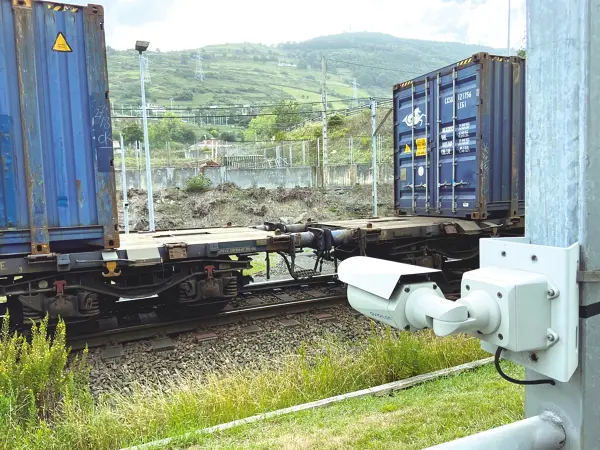
The startup AllRead offers pioneering technology that uses Machine Learning to recognise characters and text in adverse conditions. The company is positioning itself as the leading solution for automating port areas worldwide.
By Jaume Mas for Diario del Puerto.
On this link, you can read the original article in Spanish.
April 23rd, 2026.
BARCELONA. AllRead was founded just over six years ago, and in that time its technology is already deployed in 12 countries across Europe and Latin America. Born out of the Mobile World Capital’s Venture Builder programme, The Collider, the project initially operated outside the logistics and port sector — but quickly moved into the industry, identifying a clear need for automation across ports worldwide.
“Until now, every solution available in the sector was either very expensive or insufficiently precise,” says Adriaan Landman, Co-Founder and COO of the startup, speaking to Diario del Puerto. AllRead began with a gas meter reading project — a sector with limited scope and growth potential. It was then that the company entered the Port of Barcelona, with a proposal to read and identify rail wagons in real-world environments. “When you start a company, you need to find a problem that is large, urgent, and scalable,” says Landman. “And in port logistics, that problem was right there.”
Alternatives to AllRead do exist, as the COO acknowledges — but the system “is far more democratic, affordable, and reliable, because it can be deployed in any environment with a constrained budget.” Other Optical Character Recognition (OCR) technologies require significant infrastructure: large gantry structures, cameras, sensors, lighting systems. AllRead, by contrast, can be integrated with existing camera systems with minimal effort. “Traditional OCR gantries create an ideal environment and optimal conditions for capturing images and data. We do not require ideal conditions,” he states. According to the co-founder, the port logistics environment “is not ideal — it is dirty, in motion, uncontrolled, with constant flows. And that is precisely where AllRead performs.”
“The port environment is dirty, in motion, uncontrolled… That is where AllRead stands out.”
The bottleneck problem
One of the primary objectives of AllRead’s technology is to address, as far as possible, the bottleneck created by the arrival of cargo at ports. “One of the core responsibilities of a port authority is to control everything entering and leaving its port,” explains Landman. “Our technology makes that significantly easier.” He describes the quality of the system as “beyond question” — maintaining full visibility over cargo flows is a critical operational requirement for any port.
AllRead also enables faster cargo management. Beyond keeping containers accounted for, the time saved translates directly into greater operational efficiency. “If you improve modal shift and streamline processes, you reduce waiting times,” says Landman — and that, in turn, means “lower CO₂ emissions.”
The technology also delivers security improvements. “Knowing whether there is dangerous cargo on site, what condition it is in, and who is accessing specific areas provides highly valuable intelligence for controlling both the space and the people within it,” Landman explains. A port environment dense with vehicles and heavy machinery is not a safe environment by default — and reducing the number of personnel circulating in those spaces also reduces the risk of accidents.
“We want to move from access control to full port precinct intelligence.”
Continued growth
While Asia is now on the horizon, the path to entry is slow, and the company continues working towards securing a partnership in 2025. “We are in 12 countries, but we want to reach more,” Landman states. At the same time, he acknowledges there is always room for product improvement — reducing server load and expanding to new use cases are among the near-term priorities.
Longer term, the objective is to extend the traceability of all cargo entering port zones, moving beyond access control toward what Landman calls “port precinct intelligence.” The vision is to monitor the movements of both cargo and personnel, providing the data ports need to operate more efficiently — while also improving their environmental footprint and worker safety.