SUCCESS CASE:
BILBAO PORT
ACCESS CONTROL AND DANGEROUS GOODS DETECTION

This project represents one of our most ambitious digital transformation initiatives in the field of security, with the aim of replacing manual data entry with automatic data extraction using Machine Vision and Deep Learning technologies.
Bilbao Port Authority.
About Bilbao Port
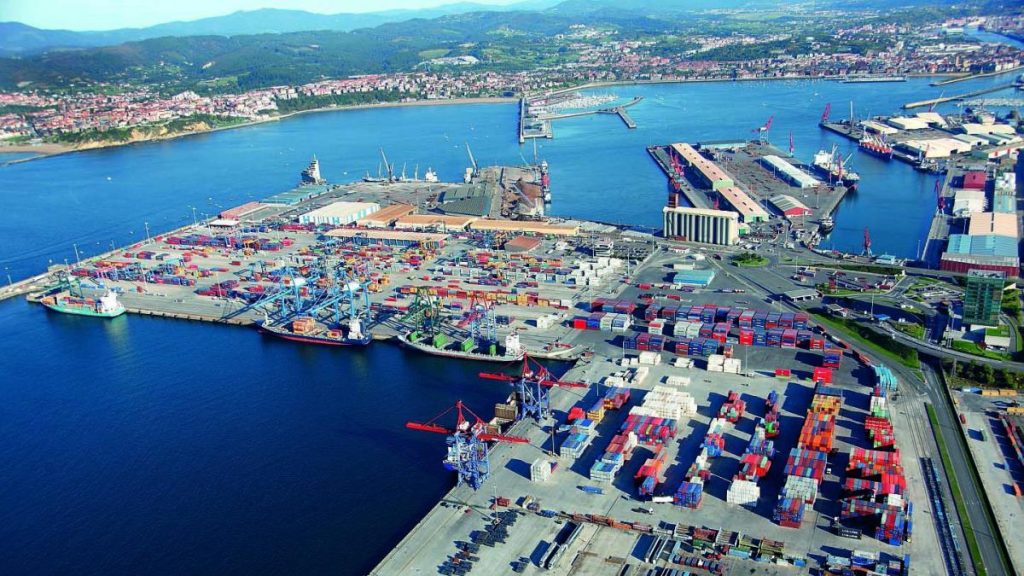
The Port of Bilbao is the main multimodal center in northern Spain and the fourth largest in the country, handling cargo traffic of around 16.6 million tons. Its capacity to adopt innovative technologies and continuously improve cargo management has positioned it as a leader in the port sector.
Challenge: Real-Time Automation and Traceability
In a port where thousands of daily operations converge, the control of dangerous goods (MMPP) is not just another process: it is a critical line between smooth operations and serious incidents. Chemicals, fuels, and potentially harmful materials demand precise verification at every access. For decades, that verification relied on phone calls, printed lists, and manual transcriptions. Today, in the Port of Bilbao, the barrier opens – or is blocked – in a matter of seconds, without human intervention.
From Phone to Operational Intelligence: 25 Years of Evolution
The Port Authority of Bilbao (APB) has followed a cumulative path that deserves to be understood in its entire history:
- 2000 — Telephone verification by the Port Police. No traceability, with a high margin of error.
- 2005 — Consultation of printed lists of the ERP by shift. Static information, which may be out of date.
- 2009 — Digital forms with data exchange via FTP. First step towards digitalization, but without real time.
- 2015 — Secure REST API. Reliable, real-time data exchange, although visual identification was still manual.
- 2020 — Turning point: implementation of Allread ARS. Manual reading gives way to automation through Machine Vision and direct integration with the ERP.
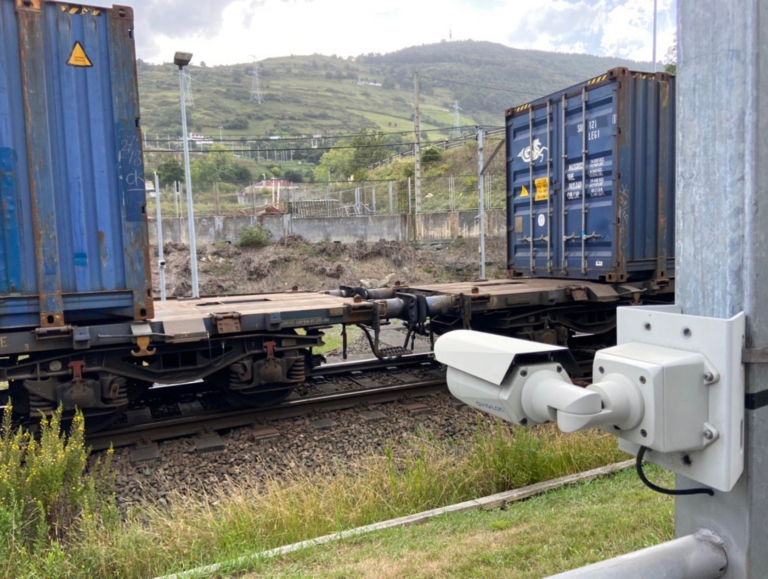
The same evolutionary pattern is reproduced in internal patrols – with the nativization of the AllRead SDK in the PortuTel app in 2025 – and in railway accesses, where the first Machine Vision camera was installed in 2022.
The Solution: Access Control with Minimal Infrastructure
Technical architecture: see, understand, decide
The core of the current system combines three layers that, integrated, generate what the APB calls operational intelligence:
1. Computer Vision and Deep Learning (Allread ARS)
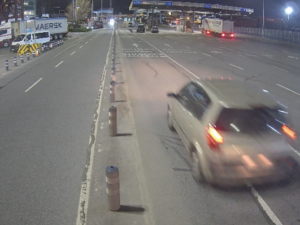
The cameras deployed at the road and rail accesses automatically read the BIC codes of containers (format XXXX 999999-9), the orange panels with a UN number and the danger pictograms of the tanks. The deep learning model continuously improves its ability to recognize, even under adverse lighting or dirt conditions.
2. Real-time integration with corporate ERP (IBM / Ecna Informática)
Each reading triggers an automatic query to the APB’s ERP, which determines in milliseconds if that MMPP is authorized to access the premises. The result is not informative: it is executive. If the load is authorized, the barrier opens. If not, it is automatically blocked and the corresponding protocol is activated.
3. Mobile Extension: SDK Nativized in PortuTel
Port Police patrols have the same decision-making capacity in mobility. They photograph the container or tank with their device, and the Allread SDK – natively integrated into PortuTel – returns the instant result (Authorized/Unauthorized) without any manual transcription of BIC, UN, or hazard class codes.
The impact was immediate: the port experienced a drastic reduction in waiting times, smoother access flows, and precise goods traceability. This initial success was so significant that the Port of Bilbao decided to expand AllRead’s solution to all its lanes.
Project Expansion
The next step was to expand the ARS solution to the rest of the lanes, totaling ten fully automated lanes. This allowed the port to manage both rail and road traffic more efficiently, increasing its operational capacity without additional infrastructure or compromising the accuracy of readings.
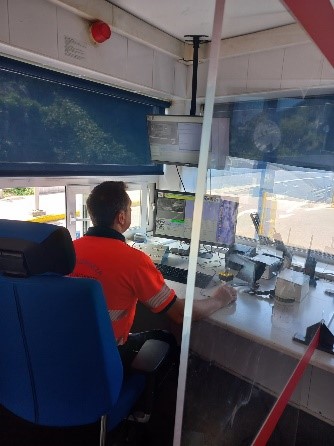
AllRead not only digitizes the captured data but transmits it in real-time to the port’s server, directly interacting with the Data Management System (Zutabeport) and the security system. This integration enables automatic barrier opening and streamlines traffic without human intervention, significantly enhancing operational efficiency.
The Result: Efficiency and Sustainability
The Head of Telecommunications and Cybersecurity at the port, Iñigo Imaz, highlighted the numerous improvements brought by the implementation of the new system. According to Imaz, “the reduction in queues at the port’s road accesses has led to shorter waiting times, reducing both costs and emissions.”
For Imaz, one of the most important advances has been the automatic detection of hazardous goods plates (HGP). “Before, this was a manual process where the port police officer had to visually verify the plate. Now, depending on the type of HGP, special protocols are deployed, such as escorting the container with a patrol,” he explained.
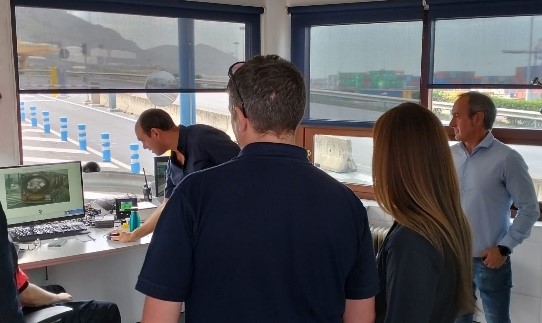
He also emphasized the improvement in operational efficiency by sharing access information with the container terminal: “The terminal can now ‘expect’ the incoming container, allowing them to improve efficiency.” Regarding rail, Imaz noted that before implementing the system, the “train map” was created visually, which led to errors, especially in adverse weather conditions. “Now, we cross-check the ‘train map’ with the data provided by the rail operator, and we also provide that information to the operator,” he added.
The collaboration between AllRead and the Port of Bilbao is a perfect example of how technology can revolutionize port logistics. Thanks to this solution, the port has optimized its operations and strengthened its leadership in the adoption of smart technologies, preparing for future challenges.
Operational impact: frictionless security at a dozen accesses
The contrast between the previous and current model is quantifiable in five key dimensions:
The benefits are distributed throughout the logistics chain: for the APB, greater control with full traceability (date of authorization, access to the port, access to the terminal, loading on ships); for carriers, elimination of unnecessary stops; For rail operators, it ensures that the same road-proven software also verifies train traffic.
Dimension | Before ✗ | Now ✓ |
Data Capture | Manual transcription, frequent errors | Real-time automatic reading |
Verification / Barrier | Manual check by agent | Instant verification + automatic ERP control |
Traceability | No photographic record | Auditable photographic evidence per operation |
Traffic Flow | Queues at access points | Control without slowing down traffic |
Unauthorized Raw Materials | Delayed detection, high risk | Immediate alert + automatic barrier lockouta |
The key that turns AI into real value
Allread ARS has been in real production since 2020: more than five years verifying MMPP with auditable results in an environment of high operational demand, on more than 10 road and rail rails. But the Port of Bilbao’s project illustrates a deeper lesson about the application of industrial AI: Artificial Vision only becomes Operational Intelligence when it is connected to the digital business ecosystem.
Without integration with the ERP, the system would read codes. With it, he makes decisions. And that distinction — between an analysis tool and a real-time decision system — is exactly where the differential value lies.
The roadmap for 2026 reflects that same logic: deployment of PortuTel with immediate post-capture alerts, consolidation of ERP integration through asynchronous queues, and installation at the Higarillo and Punta Lucero accesses. Digital transformation, in this case, was not a project. It was—and still is—a process.
If you would like to know more about this success story, contact our team.