Webinar: How Retrofit Is Changing the Economics of Road and Rail OCR Control
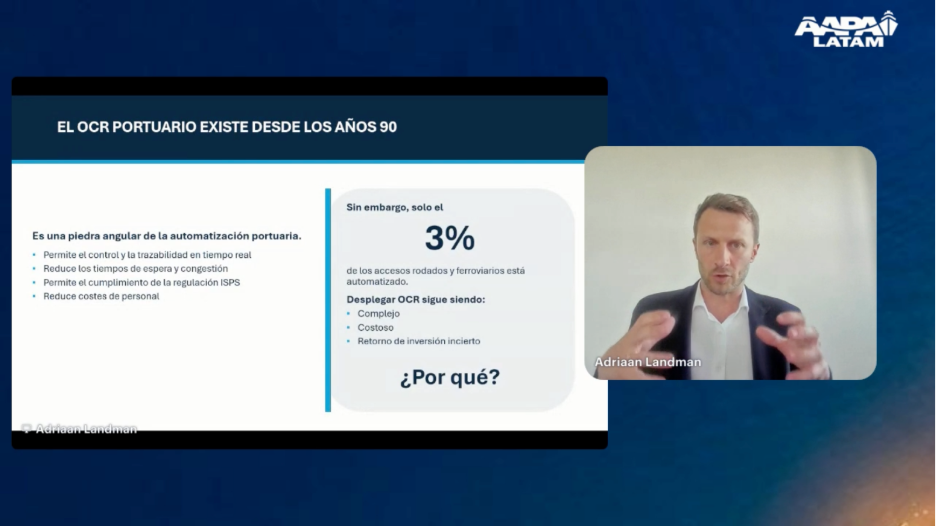
Across Latin America and the Caribbean, ports are being asked to do more with less. Traceability and security requirements keep rising. Gates stay congested during peak hours. Available space rarely grows. And budgets, in most cases, do not grow either. For port operators trying to modernize access control, the usual answer to build new OCR gates, add civil works and install new hardware has often been too expensive to justify, no matter how clear the operational case.
This is the gap that AAPA LATAM’s Voz Experta LATAM 2026 webinar set out to address on June 16th, in a session titled “Automating Road and Rail OCR Control Without the Hefty Price Tag”, automating road and rail OCR control without breaking the bank. The webinar, moderated by Juan Andrés Duarte, Executive President of AAPA LATAM, brought together port authorities, terminal operators and industry stakeholders from across the region to hear from Adriaan Landman, CEO of AllRead, on an approach that offers ports a new way to think about automation budgets: retrofit.
The problem with building gates “from scratch”
Most gate automation projects in the industry still start from the same assumption: the terminal needs new physical infrastructure, dedicated OCR portals, new gate lanes, structural works to mount cameras correctly. For a large port with capital to spend, that assumption is manageable. For the majority of port authorities, maritime terminals, inland terminals and depots, it isn’t. It is precisely why, industry-wide, a large share of container terminals still run gate control manually, despite years of available OCR technology.
The session’s starting point was blunt about this reality: growing demands for traceability and security, congested gates, limited space and tightening budgets are not separate problems. They are the same problem, seen from different departments.
Retrofit: adapting the existing infrastructure and limited space
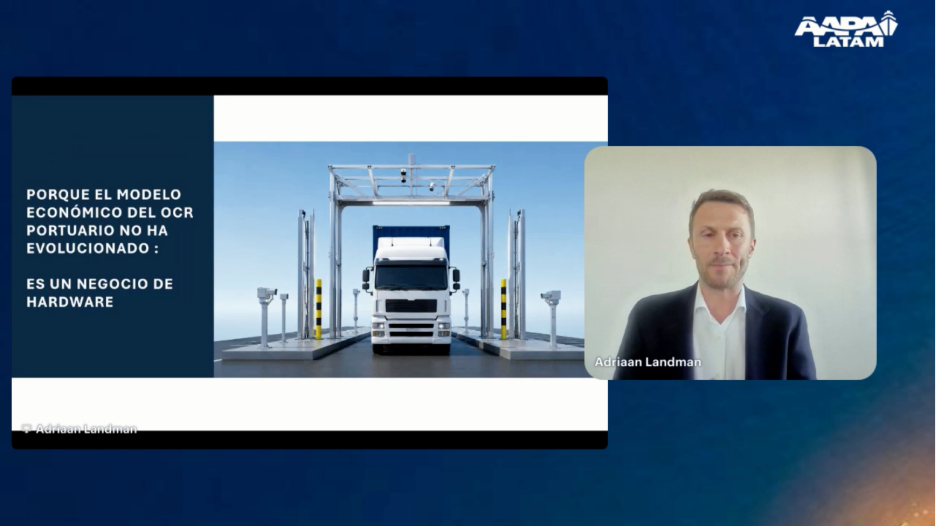
The alternative Adriaan presented is one AllRead has been refining since 2019: rather than build new OCR infrastructure, adapt to the existing setup, use the walls, poles and gate structures the port already has, and let the software do the heavy lifting. No new gates. No civil works. No hardware overkill.
It is a concept Adriaan returns to often, and for good reason: it inverts the usual capital logic of port automation. The terminal doesn’t need to rebuild its gate… It needs its existing gate to start reading and become automated.
Technically, this is possible because AllRead’s OCR runs on a patented convolutional neural network trained to read BIC codes, UIC codes, license plates, ADR/IMO dangerous goods labels and security seals directly from standard camera footage. It doesn’t depend on the precise gate-to-container alignment legacy systems require — it reads from any distance, angle or position, and even copes with damaged codes and uneven lighting, conditions where legacy OCR hardware historically struggled.
The processing happens on-premise, so the data stays on the port’s own systems and integrates directly with the terminal’s TOS or PCS.
Examples of successful deployments
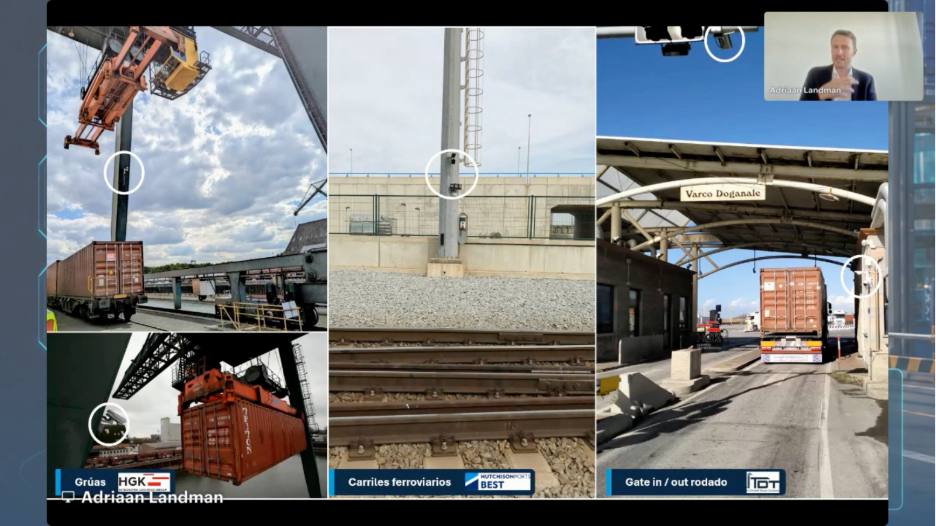
The webinar did not stop at the concept. It showed illustrated examples of automated gates around Europe and Latin America, deepened by three case studies: the Tilbury Terminal, Port Authority of Algeciras and Port Authority of Bilbao.
These three cases illustrate successful OCR deployments to automate manual, error-prone, and time-consuming tasks: at Tilbury, a minimal OCR system replaced manual data entry for arriving trains, cutting a 130-minute process for an investment under €25K, generating a 44% ROI in year one (over 300% over 3 years); at Bilbao, the port police’s manual verification of dangerous goods was replaced by real-time detection and data integration, improving traceability and traffic flow; and at Algeciras, faced with structural traffic growth and high error rates in reading license plates (trailers and Moroccan plates), an 18-month renovation of 26 road lanes and 2 rail lanes across 12 sites cut container access time from 20 to 7 seconds and raised the existing Moroccan license plate reading accuracy to 98% with real-time entry/exit monitoring integrated into the Port Community System.
These examples and references show that retrofit is not a workaround for ports that can’t afford “real” automation. It is a production-proven path used by terminals and port authorities with genuine security and traceability requirements.
A different way of framing the investment decision
The throughline of the session was less about a specific product and more about a different way of framing the investment decision. Ports do not need to choose between staying manual and undertaking a heavy infrastructure project. There is a middle path: instrument what already exists, put intelligence in the software, and get a working system in a matter of months.