The Problem Nobody Wants to Argue About, But Everyone Does
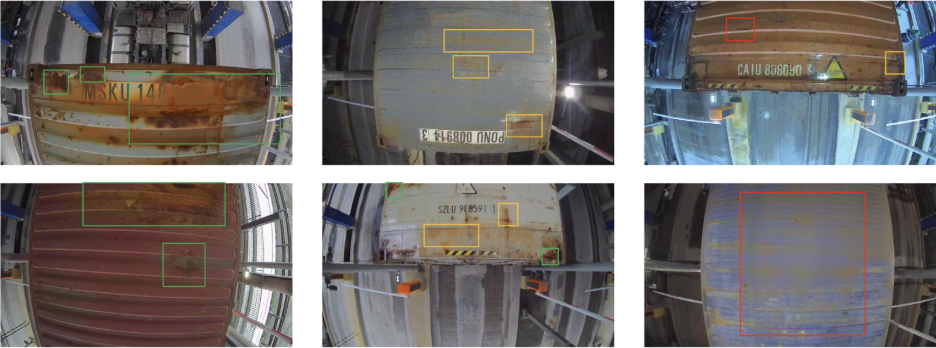
At almost every gate in the world, the same scene repeats itself: a container arrives with a dent, a scratch, a patch of rust, or a hole in the roof, and someone has to decide, on the spot, whether that damage is significant enough to record, dispute, or bill. That decision is usually made by eye, by a single inspector, under time pressure, with a truck queue behind them.
The problem isn’t that inspectors are careless. It’s that damage assessment is inherently subjective, and subjectivity doesn’t scale. What one operator classifies as “surface oxidation, not billable” another logs as “structural corrosion, chargeable.” What looks minor from a moving vehicle at a road gate looks different to someone examining the same panel up close in a workshop. In most cases, the pre-existing damage is not recorded, putting the terminal in a position of vulnerability, because nobody has the image to prove it. Multiply that inconsistency across thousands of container movements a month, and the result is a steady stream of disputed claims.
Two Separate Problems Hiding Inside One
Terminal operators trying to solve this usually discover it’s actually two problems stacked on top of each other.
The first is capture: getting a clear, consistent, well-lit image of every visible side of a container as it passes through, without stopping traffic, without adding a manual inspection step, and without depending on a single person’s vantage point.
The second is association: once you have that image, connecting it to the right container. A photograph of a dent is only evidence if it’s tied, unambiguously, to the BIC and ISO code of the specific box it belongs to, as well as the timestamp. Otherwise it’s just a picture in a folder.
Solving the first without the second produces a large, unusable image archive. Solving the second without the first means going back to manual tagging, the very bottleneck the system was meant to remove.
What Automated Damage Detection Actually Does
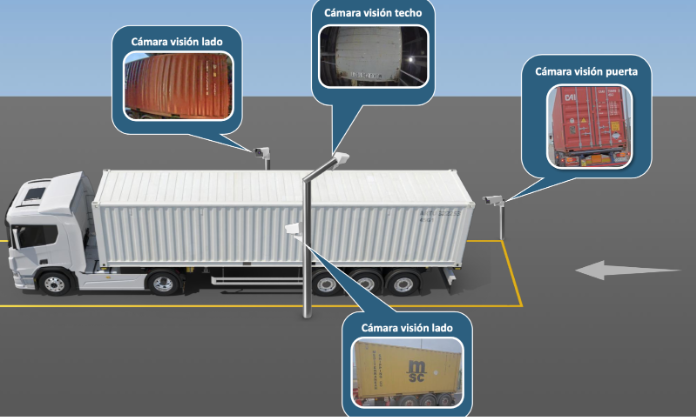
Automated damage inspection is built on computer vision. It addresses both halves of the problem in a single pass. Four cameras positioned around the inspection lane, covering both sides, the roof, and the door end, capture the visible faces of each container as it moves through, without requiring the vehicle to stop. Each camera is angled as close to perpendicular to its target surface as possible, since damage detection models perform best on a flat, direct view rather than an oblique angle.
At the same time, the system reads the container’s BIC and ISO code automatically, the same optical character recognition capability used for standard gate-in/gate-out control, and links that code to the images captured at that exact moment. The result is a structured record: this container, this timestamp, these four images. No manual matching required.
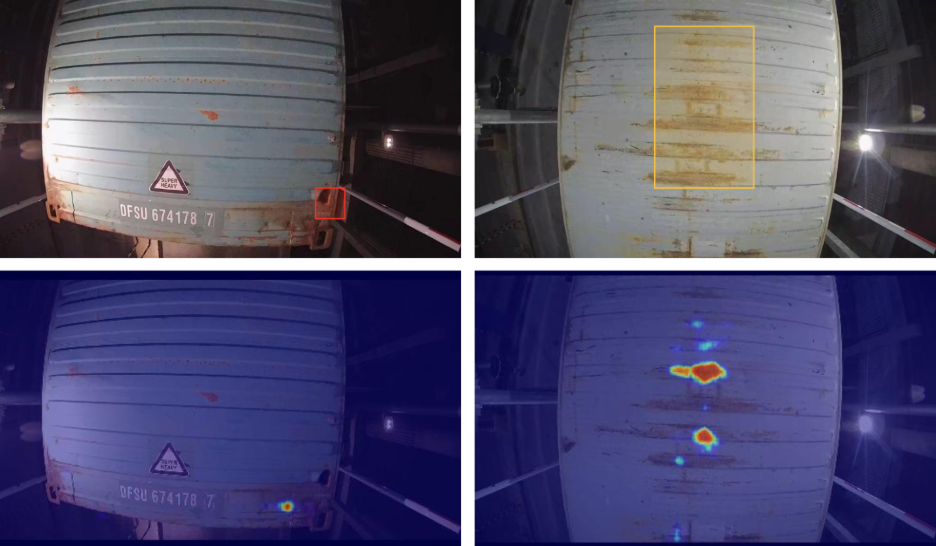
The detection layer then classifies what it sees: holes, punctures, patching, oxidation, scratches, dents. It can present the findings two ways: as a bounding box or polygon drawn directly around the affected area, or as a heat map showing where the model’s confidence in a damage classification is concentrated. Both formats are reviewable by a human operator before any decision is finalised, which matters for anyone auditing the system’s judgment.
Why “Off-the-Shelf” Doesn’t Work Here
It’s tempting to assume a damage detection model can be trained once and deployed everywhere. In practice, it can’t, and pretending otherwise is where most automated inspection projects run into trouble.
Different terminals genuinely disagree on where the line sits. Oxidation is a good example: there is no universal threshold at which surface rust becomes a chargeable defect. One operator’s “acceptable wear” is another’s “billable damage,” and a model trained on one organisation’s labelling criteria will misclassify against another’s from day one.
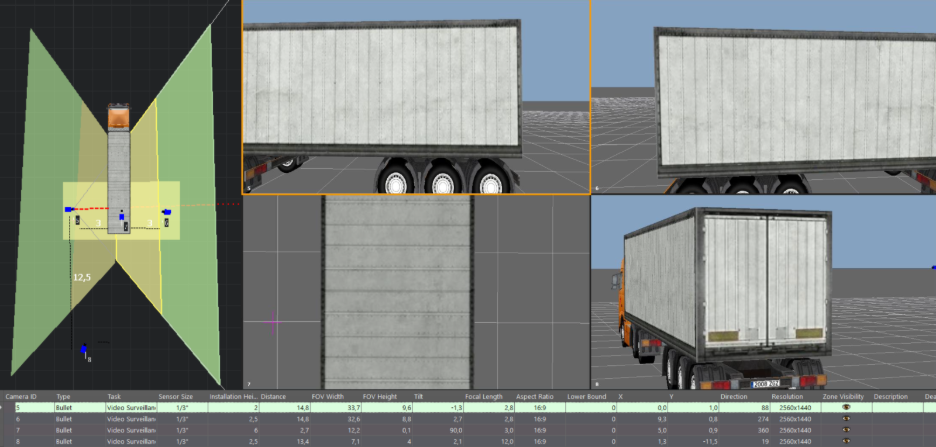
Viewing perspective compounds the issue. A gate that captures a full container side from a distance produces different training data than a workshop inspecting the same surface at close range in sections. A model has to be trained on images that match the perspective it will actually operate in, not a generic dataset assembled elsewhere.
This is why credible damage detection deployment starts with a calibration phase, not a plug-and-play install. Existing pre-classified images (where available) are used as a starting point. New images captured at the inspection point are labelled according to the operator’s own criteria, including damage types the operator prioritises and, where relevant, alignment with recognised classification standards such as ISO CEDEX. The model is then trained and evaluated specifically against that labelled set, so its output reflects the terminal’s actual criteria rather than an approximation of it.
From Setup to Full Operation
Once a model is calibrated and validated at a single inspection lane, the same configuration extends to additional gates or control points without repeating the full training cycle from scratch; each new point benefits from the model already aligned to the operator’s criteria, while continuing to feed new labelled data back in for ongoing refinement.
Every capture is stored as a timestamped, retrievable record, viewable through a transit history dashboard alongside the standard gate-in data (licence plate, BIC/ISO code, dangerous goods labels, where applicable) already being captured at the same point. For terminal operators, that means damage documentation stops being a disputed judgment call and becomes something closer to what gate data already is elsewhere in the terminal: structured, timestamped, and retrievable.
None of this replaces human judgment; a reviewer still makes the final call on liability. What it removes is the ambiguity that comes from having no image, no consistent angle, and no reliable way to tie a photo to a specific container weeks after the fact. In an industry where a single disputed damage claim can take days to resolve through manual review, that structured record is the actual return on investment, not the cameras themselves, but the certainty they make possible.