Most Auto Terminals Still Run on Human Eyes, and It’s Costing Them
You’ll see the same figure at most auto terminals: a person on foot, clipboard or scanner in hand, checking one vehicle at a time. It’s a picture that hasn’t changed much in decades, even as everything around it has become faster, bigger, and more automated.
About auto terminals
An auto terminal moves finished vehicles between transport modes, ship to rail, rail to truck, truck to compound, without losing track of a single unit. Vehicles arrive by vessel, train, or truck, are identified at the gate, and get assigned to a storage lane before being restaged and moved out in a sequence matching a stowage or loading plan. Every step depends on knowing which vehicle you’re looking at and whether it matches what your system expects.
An auto terminal juggles thousands of unique, high-value, easily damaged units, each with its own identity, paperwork, and handling rules, in compounds holding a few thousand to tens of thousands of vehicles. Identification and reconciliation have to keep pace with the physical flow, smoothly and without mistakes.
Where the cracks show up
Most terminals still identify every vehicle by hand: operators read VINs, tally vehicles by eye as a train rolls in, or type codification plates into a scanner. Across thousands of daily movements, that becomes the terminal’s biggest source of friction:
No automatic confirmation: no real-time way to confirm the vehicle in front of an operator matches the inventory record.
Manual entry, manual errors: a misread VIN or codification plate ripples into wrong records, extra checks, or gate rejections.
Weak evidence when something goes wrong: a missing unit, damaged vehicle, or wrong-vehicle load becomes one person’s word against another’s, with no record of the moment.
Costs of the current frictions
None of this is free. Detention and demurrage fees climb fast when gate processing is slow or inventory can’t be confirmed, and demurrage alone can run into hundreds of dollars per day, per unit. Misidentified vehicles mean missed slots, longer dwell times, and worst case misloads. And when a dispute arises, inconsistent evidence between the parties means many claims never get cleanly resolved; the cost is absorbed rather than attributed.
Automatic, verified events as solution
AllRead’s computer-vision solutions are built to close the gap between current state and ideal situation, turning manual, one-at-a-time checks into automatic, time-stamped, evidence-backed digital records.
VIN capture at the gate
Since finished vehicles arrive without a licence plate, the terminal needs to capture the vehicle’s VIN. Instead of an operator visually verifying or scanning a VIN at every checkpoint, cameras automatically capture VINs on gate-in and gate-out, reconcile what’s physically present against the expected inventory, and flag mismatches, duplicates, or unexpected vehicles instantly. Every event — vehicle identity + time + location + image — becomes a traceable record, so when something does go wrong, there’s real evidence to investigate it, not a memory of who was standing where.
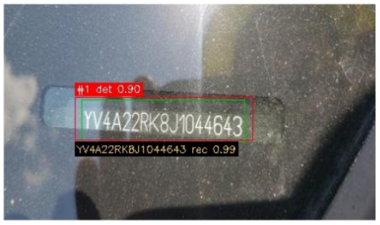
AllRead’s VIN OCR reading and verifying a windshield VIN in real time.
Automatic vehicle counting on car-carrier trains
When a car-carrier train arrives with a manifest for 210 vehicles, someone still has to confirm 210 actually passed the gate. Today, usually a person doing a visual tally as the train comes in. AllRead adds an automatic, independent count of every vehicle on the train as the composition passes, backed by images, without stopping the train. Combined with automatic UIC wagon-number reading, that produces a complete train map; wagon identities plus total vehicles detected. It is then automatically reconciled against the manifest, freeing operators for higher-value work instead of counting.
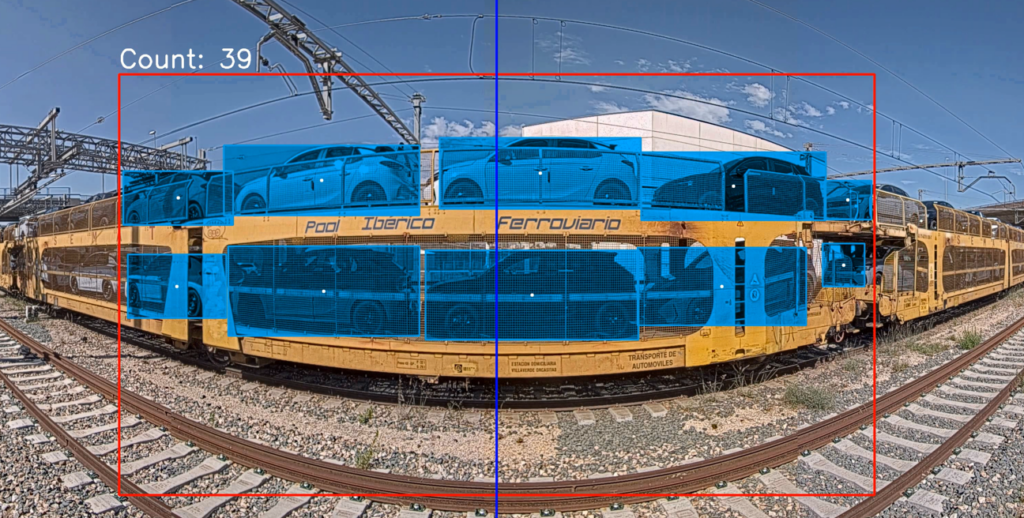
Counting cars on a passing train
Vehicle recognition: brand, model, colour
It’s not always possible to capture a vehicles’ VIN and they arrive at the terminal without license plate, so how can it be verified that the correct cars are entering? AllRead’s vehicle recognition now captures brand, model and colour alongside the plate, covering 54 vehicle brands across 966 models plus 10 truck brands across 50 models, with an “others” class so unrecognised vehicles get flagged instead of guessed. The cars are automatically read and checked against the expected inventory. Every car becomes a complete event; vehicle profile + time + location + image. A verifiable proof of what car entered or left the terminal, at what time and with an image to back it up.
The common thread
All three solutions replace the same weak link: a person trying to visually confirm identity, quantity, or compatibility, one unit at a time, with no record left behind if it’s wrong. Automating that single step, capture, reconcile, timestamp, is what turns a terminal’s biggest source of manual friction into one of its most reliable data streams, with the evidence to back it up whenever a question comes up.
If your terminal is still depending on someone walking up to a vehicle to confirm it’s the right one, there’s a faster, more reliable way to know. Let’s talk!