Ask anyone who has installed an OCR portal at a port, rail terminal or logistics gate where the money went, and the answer is rarely “the software.” It went into concrete, steel and equipment: foundations for gantries, trenches for cabling, certified cameras and sealed processing units.
That model made sense when reading a BIC container or UIC wagon code required perfectly controlled conditions. It no longer does. Modern computer vision can read reliably from standard IP cameras mounted on poles or walls. The result: a traditional OCR portal can cost up to €150.000, while AllRead delivers for three to five times less.
What a traditional OCR portal really requires
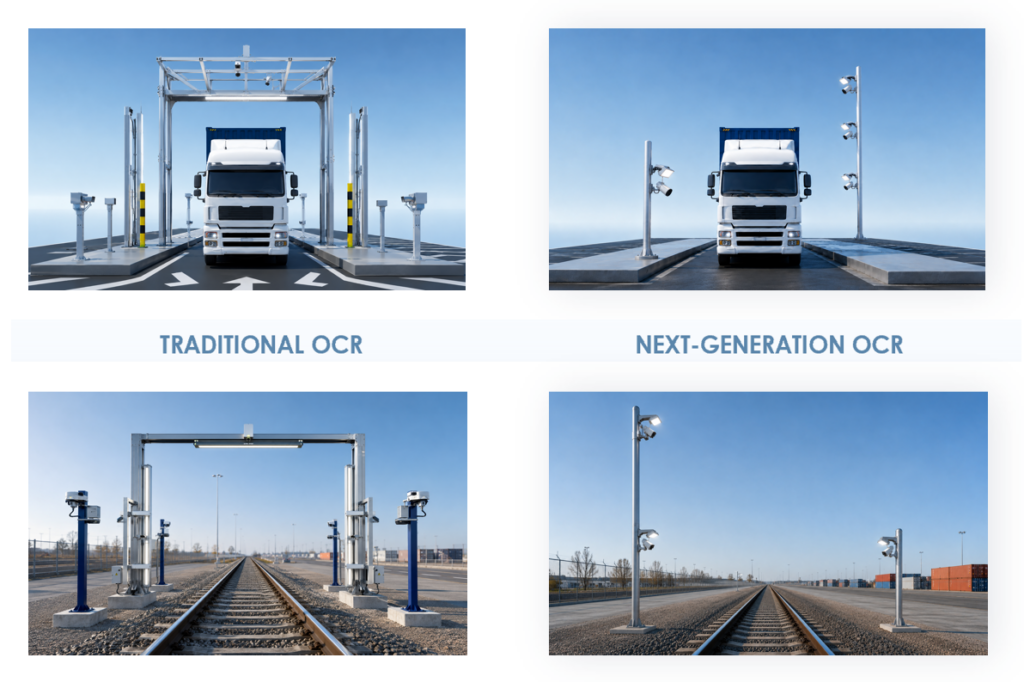
A traditional OCR installation is less a technological project than a construction project. Before a single code is digitized, the site typically needs:
- Civil works. Foundations for the gantries and trenches for cabling, often meaning lane closures and weeks of disruption.
- A metal gantry per lane. A custom steel structure built to hold the system’s equipment in fixed positions.
- Proprietary industrial cameras. Certified by the manufacturer, usually six or more per checkpoint. Existing CCTV cannot be reused.
- Synchronized lighting. A proprietary strobe or IR unit fired in sync with a trigger.
- Trigger sensors. Inductive loops cut into the pavement and/or LiDAR scanners to detect vehicles and fire the cameras.
- A closed processing unit. Dedicated manufacturer hardware whose CPU, RAM and storage you cannot configure or reuse.
- Significant dedicated cabling. Separate lines for signal, triggers and strobe synchronization.
Every one of these components adds cost, installation time and a dependency on a single vendor for maintenance and spare parts.
The AllRead approach: intelligence instead of infrastructure
AllRead’s next-generation OCR moves the hard work from hardware into software. Our computer vision models are trained to read codes in real-world conditions, so the site no longer has to be engineered around the camera.
- Little or no civil work. Cameras mount on existing poles or structures. If needed, single poles are installed. No gantry. Works in tight spaces.
- Standard IP cameras. Commercial models from brands such as Avigilon, AXIS, Hikvision and Dahua.
- Reuse of existing CCTV. Any camera with at least 4 MP resolution and 24+ fps is compatible.
- Fewer cameras. 1 to 5 per checkpoint, depending on the use case.
- Standard lighting. Off-the-shelf white light (for example, Raytec), or IR for license plates.
- No trigger sensors. Vehicles are detected by computer vision, with no loops or LiDAR.
- Your own server. Runs on your physical or virtual server, on-premises, using standard hardware that is expandable and reusable.
- Minimal cabling. Everything travels over the existing IP network.
Side by side
|
Component |
Traditional OCR |
AllRead next-generation OCR |
|
Civil works |
Required: gantry foundations, cabling trenches |
Not required or minimal |
|
Metal gantry |
Custom steel structure per lane |
Not required; uses existing poles |
|
Camera type |
Proprietary, manufacturer-certified |
Standard commercial IP cameras |
|
Reuse of existing CCTV |
No |
Yes (4 MP+, 24+ fps) |
|
Cameras per checkpoint |
6+ |
1 to 5 |
|
Lighting |
Proprietary strobe or IR synced with trigger |
Standard white light, or IR for plates |
|
Vehicle detection / trigger |
Inductive loops and/or LiDAR; pavement cutting |
Not required; computer vision detection |
|
Processing server |
Closed manufacturer unit |
Your physical or virtual server |
|
CPU / RAM / storage |
Fixed, not configurable |
Standard, expandable, reusable |
|
Dedicated cabling |
Significant: signal, trigger, strobe |
Minimal; existing IP network |
3× cheaper means ROI 3× faster
Remove the gantry, the trenches, the loops, the LiDAR and the proprietary boxes, and the hardware and infrastructure bill drops. Same data output, a fraction of the investment.
Because the upfront cost is lower, the payback period shrinks accordingly: 3× cheaper means payback 3× faster. And since the cameras and servers are standard equipment, they remain your assets. They can be repurposed, expanded or replaced without going back to a single manufacturer. In the words of João Oliveira, Head of Operations at AllRead: “During a retrofit project on an existing gate, we were confronted with hardware from a traditional OCR provider that we couldn’t reuse because it was proprietary. It was our client’s hardware, yet they couldn’t use it as they pleased!”
There are operational savings too. No pavement cutting means no lane closures during installation, and no proprietary spare parts means simpler, cheaper maintenance for years after go-live.
From design to deployment in 3 to 4 months
Less infrastructure also means a faster project. Our average deployment takes 3 to 4 months, following five steps:
- Scope definition. Needs analysis, then defining objectives and deliverables.
- Solution design. Technical requirements, output files and proposal confirmation.
- Infrastructure preparation. Preparing the hardware and network, mostly on what is already in place.
- Software configuration. Custom software settings for each lane and use case.
- Testing and rollout. KPI evaluation and integration with your TOS or PCS.
The bottom line
Traditional OCR asks you to build around the technology. AllRead fits the technology around what you already have: your process, your poles, your cameras, your network and your servers. Fewer components, less construction, no vendor lock-in, and a payback period three times shorter.
Want to know how much of your existing infrastructure AllRead can reuse? Contact us for a site assessment.